
Engineering service · next engagement
Pre-Bid and Tender Engineering for EPC Contractors
Tender, specification and MDL review, scope break-up, preliminary SLD and layouts, quantities, offer and GTP comparison, and clarifications, so an EPC bid is priced against stated assumptions. For substations, renewable and storage projects, lines and HVDC packages.
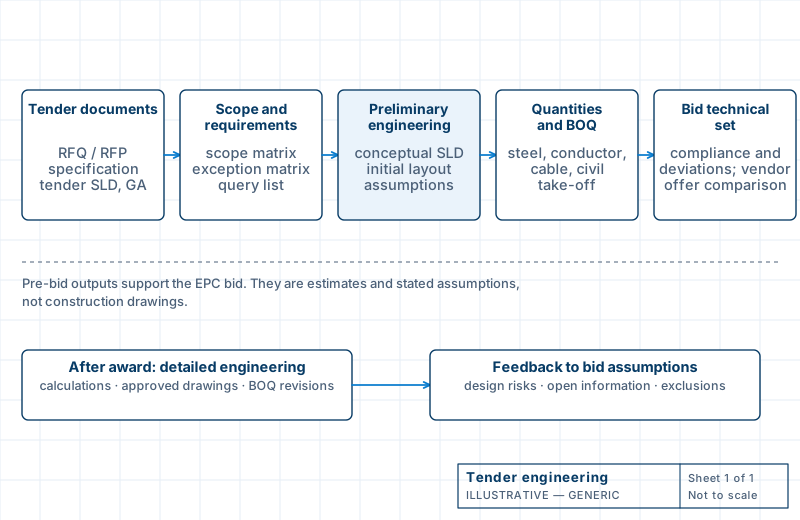
Engagement stages
| Stage | Typical CoreGrid work |
|---|---|
| Pre-bid | Tender, specification and MDL review; scope break-up; preliminary SLD, GA and indicative layouts; quantities and BOQ; civil and electrical take-off; vendor offer and GTP comparison; technical clarifications and deviations; estimation inputs; risk and interface register |
| Detailed design (after award) | Design criteria, drawings and calculations, equipment layout and vendor coordination, BOQ, submissions and CRS to approval. See detailed engineering. |
| Additional support, as contracted | Construction engineering queries, inspections, SCADA signal mapping, commissioning advisory and O&M technical support. See site support. |
We work for the bidder or its client as an engineering consultant. We are not the EPC contractor, and we do not give approvals on another party’s behalf.
Section 01
How pre-bid engineering helps an EPC bid
An EPC bid has to be priced before the design exists. The tender provides a specification, a single-line diagram and often a layout, but the quantities that follow from them (steel, conductor, cable, concrete, earthing) depend on engineering decisions the bidder has not yet made. Gaps and ambiguities in scope surface after award, when they are expensive to resolve.
Pre-bid engineering narrows that uncertainty. By reading the tender closely, setting out what is and is not in scope, and preparing preliminary engineering, we help the bid team price against stated assumptions rather than guesses. It does not guarantee savings or a competitive result, and the estimate is only as good as the information the tender provides.
What this is not. Pre-bid outputs are estimates, concept drawings and assumptions. They are not approved designs and are not issued for construction. Detailed design after award is a separate stage with its own inputs.
Section 02
Tender analysis
Tender analysis starts with the RFQ or RFP and its technical specification. We review eligibility and scope interfaces, evaluate the specification, read the tender single-line diagram and general arrangement, and note site constraints stated in the tender. From that we prepare a requirement and exception matrix and a clarification list, and record the drawing and MDL obligations the contract will impose.
The matrix shows, requirement by requirement, what the bidder will be committing to and where wording is unclear, so queries can be raised within the tender period.
- RFQ / RFP review
- Specification and MDL review
- Scope break-up and interfaces
- Tender SLD and GA review
- Site constraints from the tender
- Requirements and exception matrix
- Clarifications and deviations list
- Risk and interface register
Section 03
Preliminary engineering
Preliminary engineering gives the bid team something concrete to estimate from. We prepare a conceptual single-line diagram, initial bay and yard configurations, and footprint and equipment area assumptions, and, where the tender allows, preliminary structural and foundation quantities. Basic cable, earthing, steel and conductor take-off assumptions are recorded alongside, so every number can be traced to the assumption behind it.
- Preliminary SLD
- Indicative layouts and bay configuration
- Footprint and equipment area assumptions
- Preliminary structural and foundation quantities, as allowed
- Civil and electrical take-off assumptions
- Tender drawings, where the bid requires them
Section 04
BOQ and EPC estimate support
Quantity take-off covers primary equipment, yard steel, conductor, insulators, foundations, cable systems, structures, civil works and the engineering deliverables themselves, but only where defensible design assumptions exist. Alongside the quantities we note procurement and vendor scope interfaces, support costing with assumption notes, and state a basis of estimate so estimators know what each quantity does and does not include.
We do not promise take-off accuracy beyond what the tender information supports, and we say where a quantity is a placeholder awaiting approved engineering inputs.
- Primary equipment quantities
- Yard steel, conductor and insulators
- Foundations and civil works
- Cable systems and structures
- Engineering deliverables as scope items
- Procurement and vendor interface notes
- Costing support and assumption notes
Section 05
Bid technical documents
The bid technical set pulls the work together: a technical compliance and deviation statement in the format the tender requires, the register of tender queries, review of vendor offers and GTP, a technical comparison, notes on risk and exclusions, the basis of estimate, the tender SLD and drawings, and a bid deliverable matrix showing what will be produced after award.
- Technical compliance and deviation statement
- Tender queries and responses
- Vendor offer and GTP comparison
- Technical bid evaluation support
- Risk and exclusions note
- Basis of estimate and cost estimation inputs
- Tender SLD and drawings
- Bid deliverable matrix
- Technical presentation support for the bid team
Section 06
Estimation is not detailed design
| Pre-bid engineering | Post-award detailed engineering | |
|---|---|---|
| Purpose | Support pricing and the bid submission | Produce the design for construction |
| Information | Tender documents and stated assumptions | Approved specification, vendor data, site and soil data |
| Drawings | Concept SLD and initial layout | Controlled drawings and calculations for approval and construction |
| Quantities | Estimated, with a basis of estimate | Derived from approved drawings |
| Status | Not an approved design | Reviewed and approved by the client |
Outputs are phased to the tender calendar: the requirement matrix and query list come first so that questions can be raised early, followed by preliminary engineering, quantities and the basis of estimate, and finally the technical bid documents. Where an EPC contractor wins the work, the pre-bid assumptions carry forward into post-award design, and differences are recorded rather than hidden.
Related
Share the tender extract for a pre-bid scope discussion
Send the tender specification, SLD and any layout drawings, together with the bid submission date. We will confirm the outputs that can be delivered in the time you have.