
CoreGrid Engineering

Infrastructure sector

Battery Energy Storage Systems (BESS) Engineering & Grid Integration

System sizing and configuration, electrical balance of plant, civil works and grid interconnection for grid-scale and hybrid battery storage, coordinated with the battery OEM and specialist parties.

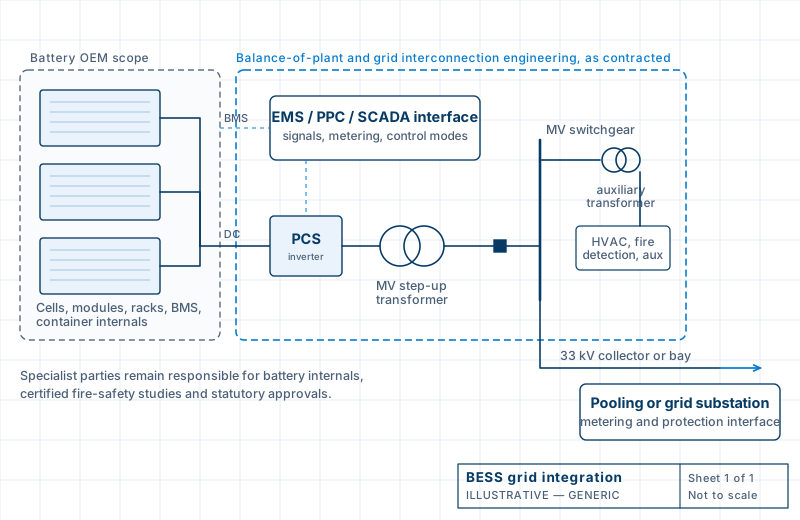
Generic BESS diagram: battery containers, PCS, MV step-up transformer, switchgear and connection to a pooling substation, with OEM and engineering boundaries
BESS grid integration and scope boundaries. Generic illustration.

Three scopes of BESS engineering

Each project states which of these it includes. They can be taken together or separately.

Scope 1

System planning, sizing and configuration

Where offered for a project: translating the application into power and energy ratings. We work through the MW and MWh requirement, usable capacity and depth of discharge, round-trip efficiency, auxiliary consumption, duty cycles and the degradation the project assumes, then propose a block configuration with the OEM’s data.

Scope 2

Electrical balance of plant and grid interconnection

PCS and MV step-up transformer interfaces, MV switchgear and collection, SLD, auxiliary supply, cables, earthing and lightning protection, protection and control, metering, SCADA/EMS/PMS interfaces, and the connection to a pooling or grid substation, together with the associated civil works.

Scope 3

OEM coordination, reviews and commissioning support

Review of OEM and supplier documents, safety and fire-protection compliance reviews against the project requirements, HVAC and auxiliary interfaces, and commissioning and performance-validation support as agreed. Statutory approvals and certified studies remain with qualified specialists.

Typical scope by document type

Electrical drawings

  • BESS eBoP SLD; collector / MV connection
  • Container, PCS and transformer layout
  • Cable routing and earthing / lightning layouts
  • Auxiliary distribution; EMS / SCADA / protection interface drawings

Design / sizing calculations

  • MW / MWh capacity, duty-cycle, backup and efficiency sizing
  • PCS and step-up transformer ratings
  • Cable sizing and auxiliary load
  • Earthing

Grid / power system studies

  • Load flow and short-circuit
  • Reactive power
  • Harmonics / power quality
  • Grid interconnection and protection, where scope permits

Civil & structural

  • Container, PCS and transformer foundations
  • Access, drainage and trenches
  • Safe spacing and fire-protection civil interfaces to approved OEM codes

BESS capacity sizing (MW/MWh) is not the same as sizing the 220 V / 48 V station battery of a substation. Cell, module and BMS details remain with the OEM, and certified fire studies and statutory approvals with qualified specialists and the authorities. No BESS project is claimed.

Inputs

InputTypically fromUsed for
Application and service requirement (shifting, firming, frequency support)Owner or EPC contractorSizing basis and duty cycle
Required MW, MWh and duration at the connection pointOwner, connection approvalSizing and configuration
Battery and PCS data, efficiency, auxiliary loads, degradationOEMInstalled capacity, auxiliary design
Connection point, fault level, grid requirementsUtility, system studySLD, protection, metering, studies
Site layout, soil data, spacing and safety requirementsOwner, OEM, applicable codesBlock layout, civil design, earthing

Who is responsible for what

A typical split. The contract and the OEM agreement decide the actual boundaries.

ItemCoreGrid (as contracted)Battery OEMSpecialists and authorities
Cells, modules, racks, BMS, container internals—Design and supply—
Sizing basis and configurationPrepare or reviewProvide data and confirm—
PCS, transformer and switchgear interfaces, SLDPrepareProvide PCS data—
Auxiliary supply, cables, earthing, lightning protectionPrepareProvide auxiliary loads—
Foundations, plinths, trenches, drainagePrepareProvide loads and fixings—
Protection, control, EMS/SCADA interface listsPrepareProvide BMS/PCS interface dataUtility requirements
Fire protection and safetyCompliance reviewProvide safety documentationCertified studies and approvals
Commissioning and performance testsProcedure review and support, as agreedPerform tests on its systemWitness where required

Example: connecting a BESS to a pooling substation

On a hybrid renewable project, the BESS often connects to the same pooling substation as the solar or wind plant. The storage blocks connect through PCS units and MV transformers to a 33 kV feeder or a dedicated bay on the pooling substation’s collector bus. Its power then shares the pooling transformers and evacuation line with the plant.

That arrangement means the bay rating, protection settings interface, metering and plant controller have to account for charging and discharging, and the evacuation capacity has to be checked for combined operation. We coordinate the BESS bay with the pooling substation design and with the EMS or plant controller interface.

  • Dedicated BESS bay or feeder on the 33 kV collector bus
  • Bay rating for charge and discharge
  • Protection and metering for bidirectional flow
  • EMS or plant controller interface with SCADA
  • Evacuation capacity check for combined operation

Pooling substations

Typical deliverables

Calculations

BESS sizing, auxiliary load and transformer sizing, cable sizing, earthing study.

Drawings

BESS SLD, block layout and spacing plan, earthing and lightning layout, foundation drawings.

Schedules

Auxiliary load list, cable schedule, protection, control and EMS/SCADA interface list, BOQ.

Reviews

OEM document review, safety and fire-protection compliance review, test procedure review.

BESS items in the deliverables library

Share your SLD, technical specification or MDL for an engineering proposal

Send us the tender extract, single-line diagram, master deliverable list or the specific calculation you need. We will confirm scope, inputs and a realistic submission sequence before any work starts.