CoreGrid Engineering

Company profile

About CoreGrid Engineering

A multidisciplinary engineering consultancy for power transmission, substation, renewable-energy and storage infrastructure, working with EPC contractors and other project stakeholders from tender to final submission.

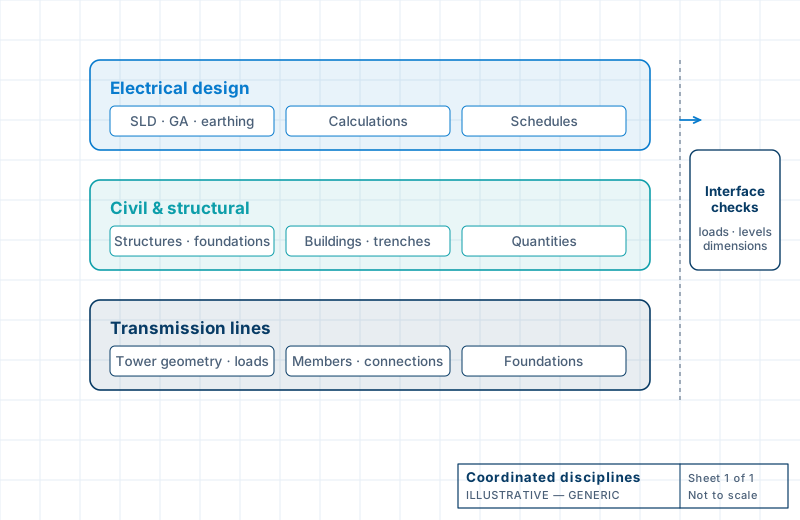
Generic diagram of electrical, civil and transmission disciplines coordinated through interface checks

Section 01

Who we are

CoreGrid Engineering is a multidisciplinary engineering consultancy supporting the design and development of power transmission, substation and renewable-energy infrastructure. Our services span AIS and GIS substations, renewable pooling and evacuation systems, battery energy storage integration, transmission lines and HVDC stations, with the electrical, civil and structural engineering each of them needs.

We work with EPC contractors and other project stakeholders from tender-stage technical assessment to post-award detailed design, preparing coordinated drawings, engineering calculations, schedules and technical documents to the applicable project specifications. Detailed design engineering is our primary service; pre-bid engineering is the next.

Section 02

Our role in EPC and power infrastructure

A power project involves several parties. The owner or developer sets the requirements and holds the asset. The utility sets the connection, metering and protection rules. Equipment manufacturers design and supply their own equipment. The EPC contractor designs, procures and builds the works under contract. Our role sits inside that structure: we prepare the engineering the contracting party needs, usually the EPC contractor, and submit it for review by the client or its consultant.

That role decides how we describe our work. We prepare, check, submit and revise; approval belongs to the party the contract names. We do not construct, supply or operate, and we do not certify on another party’s behalf.

PartyTypical role
Owner or developerRequirements, approvals, asset ownership
UtilityConnection, metering and protection rules
EPC contractorDesign, procurement and construction under contract
Equipment OEMEquipment design, data and supply
CoreGrid EngineeringEngineering design, studies and review, as contracted

Section 03

Our engineering domains

Electrical and civil/structural are our disciplines. Substations, renewable plants, pooling stations, storage, lines and HVDC stations are the infrastructure we apply them to.

InfrastructureElectricalCivil & structural
Substations & switchyards✓✓
Solar, wind & hybrid plants✓As contracted
Pooling substations✓✓
Battery energy storage✓✓
Transmission linesLine electricalTowers & foundations
HVDC stationsAs contractedAs contracted

Section 04

Electrical design & engineering

System and bay design, AIS and GIS layouts and clearances, conductor and busbar sizing with short-circuit forces and sag-tension, earthing and lightning protection, equipment sizing and selection, station auxiliary AC and DC systems, cables and illumination, with protection, control and SCADA interfaces where in scope. Power-system studies are offered by scope and stated in each proposal.

Electrical design & engineering   Engineering studies

Section 05

Civil & structural engineering

Site grading and plot plans, steel gantries and equipment supports, transformer and reactor foundations with oil containment, control and GIS buildings, cable trenches and duct banks, drainage, roads and fencing. Designs follow the geotechnical data, the equipment loads and the structural criteria the client specifies, with reinforcement drawings, bar bending schedules and quantities.

Civil & structural engineering

Section 06

Transmission engineering

AC transmission lines up to 765 kV: conductor and earth wire selection, losses and corona checks, route and tower spotting where in scope, single and double circuit tower design with load trees, member and connection design, sag-tension and stringing charts, and tower foundations by soil class. Tower types follow each project’s own tower schedule.

Transmission lines

Section 07

Renewable energy, pooling and BESS engineering

Utility-scale solar, wind and hybrid plants reach the grid through collector networks, pooling substations and evacuation lines. We engineer those links: plant electrical balance of system, collector systems, pooling substation electrical and civil design, and battery storage sizing, balance of plant and grid integration, coordinated with equipment manufacturers and the utility’s requirements.

Solar, wind & hybrid   Pooling substations   BESS

Section 08

HVDC and specialised services

For HVDC schemes we offer converter-station engineering, equipment specification and review, and study support, with the boundary to the converter manufacturer agreed for each project. Alongside our design work we offer engineering studies, equipment and offer reviews, quality inspections and test witnessing, and site, commissioning and O&M technical support, each as contracted.

HVDC engineering   Equipment & GTP review   Site & O&M support

Section 09

Our approach to technical design

Every package converts project data into design in the same order. We log the inputs (specification, SLD, MDL, bay list, equipment data, site and soil information), fix the design criteria and record assumptions, prepare calculations, develop drawings from the results, and check the interfaces between disciplines before anything is issued.

The interfaces matter most, because one discipline’s output is another’s input. The table shows typical examples. We pass these items between disciplines as controlled data rather than informally, so a change in one place is traced through the drawings it affects.

When this is fixedIt drives
Transformer arrangementGeneral arrangement, foundation and oil-pit design, fire separation
Bus short-circuit forces and sag-tensionGantry and support loads, then foundation design
Grounding study resultsEarth mat layout, conductor sizes and equipment bonding
Equipment vendor drawingsSupport spacing, anchor bolts and cable routes
Solar or wind pooling layoutTransformer bays, collector circuits, control room and evacuation design

Section 11

Why clients engage CoreGrid

Coordinated drawing packages

Drawings in a package should agree with each other on dimensions, levels and equipment positions. We cross-check electrical layouts against civil, structural and vendor information before issue, so reviewers meet fewer contradictions between sheets.

Calculations traceable to inputs

Each calculation states its input documents, design criteria, formulae and assumptions, and records the result against the acceptance limit. A reviewer can follow the path from specification to result without reconstructing it.

Comment resolution and revisions

Review comments are logged in a comment resolution sheet with a response and the revision in which each was closed. The review history stays clear and discussions stay short.

Scope and interface gaps found early

Reading specifications and MDLs closely, we flag missing inputs, unclear boundaries between packages and interface items that no party has yet claimed. Raising these early costs less than finding them on site.

Constructability and practical layouts

Layouts are reviewed for access, maintenance space, erection sequence and cable routing, not only for minimum clearances, so site teams can build and operate the design.

Disciplined document management

Document numbering, revision control, transmittals and a drawing register are maintained throughout, in the client’s convention where one is specified.

These describe how we work and what we aim for. They are not numerical performance claims.

Section 12

Vision and mission

Vision

To be a dependable engineering partner for the power and energy infrastructure India is building: substations, transmission, renewable generation and energy storage.

Mission

To deliver fit-for-purpose engineering that matches each client’s specification, budget and schedule, with traceable calculations, coordinated drawings and controlled revisions, and to build long-term working relationships through consistent technical quality.

Looking ahead

We intend to keep developing our work in HVDC, large-scale renewables and energy storage as these sectors grow, alongside our substation and transmission engineering.

Section 13

Ways to engage

A complete package

A discipline package for a substation, pooling station, BESS or line, taken to final issue.

A calculation or study

Earthing, bus calculations, a foundation design, NGR sizing or a tower check, against your design basis.

Tender or review support

Pre-bid engineering, offer and GTP review, or site and commissioning support.

Request Engineering Proposal   [email protected]   +91-9471804100